As marinas, shipyards, and waterfront facilities continue to handle larger, more valuable, and more diverse vessels, efficient and safe boat handling equipment has become essential. One of the most widely used solutions in modern marine operations is the mobile boat hoist, also commonly known as a boat travel lift. This equipment plays a critical role in lifting boats out of the water, transporting them across the yard, and positioning them for maintenance, storage, or launching.
This article provides a comprehensive explanation of what a mobile boat hoist is, why it is used, and how it works, covering its structure, operating principles, key systems, and practical advantages. Whether you are a marina owner, shipyard manager, or project engineer, understanding mobile boat hoists will help you make informed decisions for your marine facility.
1. What Is a Mobile Boat Hoist?
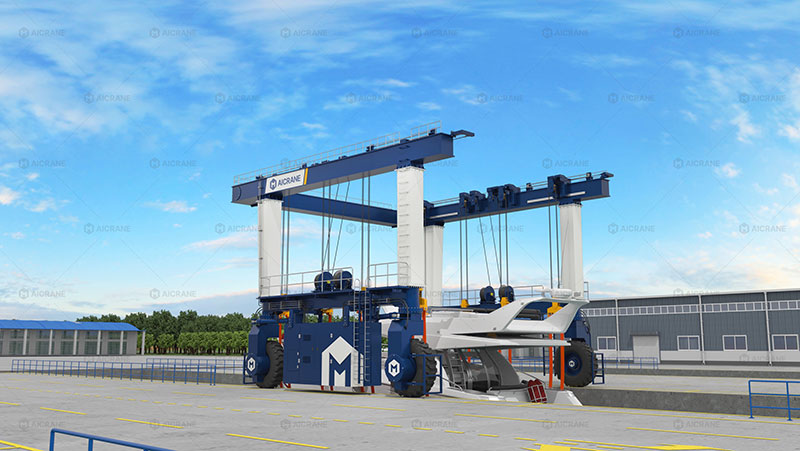
A mobile boat hoist, or known as boat travel lift or marine travel lift, is a specialized, self-propelled lifting machine designed to lift boats and yachts vertically from the water, carry them horizontally over land, and place them accurately at a designated location. Unlike fixed cranes or stationary boat lifts, mobile boat hoists can move freely within a marina or shipyard, providing high flexibility and operational efficiency.
Mobile boat hoists are typically used for:
-
Lifting vessels from water to land for maintenance or repair
-
Transporting boats within marinas or shipyards
-
Launching boats back into the water after service
-
Handling boats for seasonal storage or dry docking
Depending on design and capacity, mobile boat hoists can handle loads ranging from 10 tons to over 1200 tons, making them suitable for small fishing boats, luxury yachts, catamarans, and even large commercial vessels.
2. Why Mobile Boat Hoists Are Widely Used
Compared with traditional cranes or fixed lifting systems, mobile boat hoists offer several distinct advantages:
High Flexibility
Mobile boat hoists do not rely on fixed rails or permanent foundations. They can move between docks, slipways, and storage areas, adapting easily to changing yard layouts.
Enhanced Safety
Boats are supported by slings distributed under the hull, which reduces localized stress and minimizes the risk of hull deformation or damage.
Efficient Yard Operations
One mobile boat hoist can serve multiple lifting points, reducing equipment redundancy and improving turnaround time, especially during peak seasons.
Wide Application Range
From small marinas to large shipyards, boat gantry cranes can be customized to meet different lifting heights, spans, wheelbases, and environmental conditions.
3. Main Components of a Mobile Boat Hoist
To understand how a mobile boat hoist works, it is important to first understand its main structural and functional components.
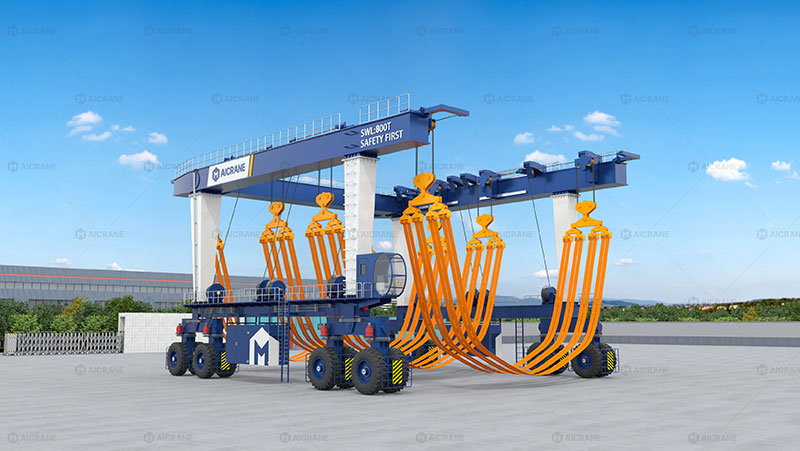
3.1 Main Steel Structure
The primary structure consists of:
-
Two vertical frames (gantries)
-
A top beam connecting the frames
This rigid steel framework provides the necessary strength to support heavy loads while maintaining stability during lifting and travel.
3.2 Lifting System
The lifting system usually includes:
-
Electric or hydraulic hoisting mechanisms
-
Wire ropes or chains
-
Spreader beams and lifting points
The system raises and lowers the slings in a synchronized manner to keep the vessel level throughout the operation.
3.3 Sling System
Slings are flexible, high-strength belts that pass under the hull of the boat. Proper sling arrangement is critical, as it:
-
Distributes the load evenly
-
Protects the hull surface
-
Accommodates different hull shapes
3.4 Traveling and Steering System
Mobile boat hoists are equipped with:
-
Rubber tires designed for heavy loads
-
Independent or synchronized wheel drives
-
Multiple steering modes such as straight, four-wheel steering, or crab steering
This allows precise maneuvering in narrow marina spaces.
3.5 Power System
Depending on site conditions and environmental requirements, mobile boat hoists may use:
-
Electric power (cable reel or battery-powered)
-
Diesel engines
-
Hybrid systems
3.6 Control System
Operators can control the hoist via:
-
Cabin-mounted control panels
-
Wireless remote control systems
Modern control systems often include load monitoring, anti-sway features, and emergency stop functions.
4. How Does a Mobile Boat Hoist Work?
The working process of a mobile boat hoist can be divided into several key stages, each requiring coordination between mechanical, hydraulic, and control systems.
Step 1: Positioning Over the Vessel
The mobile boat hoist drives over the boat while it is floating in the water. The wide span of the hoist allows it to straddle the vessel, positioning the lifting frame directly above the hull.
Precise positioning is achieved using slow-speed travel and fine steering adjustments, ensuring the slings can be lowered accurately.
Step 2: Sling Placement
Once positioned, slings are lowered into the water and carefully guided under the hull. Operators ensure:
-
Correct sling spacing based on vessel length and weight
-
Clearance from propellers, rudders, and stabilizers
-
Even load distribution
This step is critical for preventing hull damage.
Step 3: Lifting the Boat
The lifting system is activated to raise the slings simultaneously. As the boat is lifted:
-
Water drains from the hull
-
Load sensors monitor weight distribution
-
The control system keeps the boat level
The vessel is raised to a safe transport height, fully clear of the water.
Step 4: Transporting the Boat
With the boat securely suspended, the rubber tyred crane travels to the designated area. Advanced steering modes allow:
-
Smooth movement over uneven ground
-
Precise alignment in tight spaces
-
Reduced ground pressure through multiple wheels
During transport, speed is kept low to maintain stability and safety.
Step 5: Lowering and Positioning
Once at the target location, the hoist lowers the boat onto:
-
Boat stands or cradles
-
Maintenance blocks
-
Storage racks
After the load is fully supported, slings are released and removed.
Step 6: Launching (Reverse Process)
For launching, the process is reversed. The hoist lifts the boat from land, transports it to the water, and gently lowers it until it is floating freely.
5. Key Safety Features in Mobile Boat Hoists
Safety is a primary consideration in boat handling operations. Modern mobile boat hoists are equipped with multiple safety systems, including:
-
Overload protection devices
-
Emergency stop buttons
-
Anti-sway and synchronization control
-
Hydraulic pressure monitoring
-
Wind speed alarms for outdoor operations
These features significantly reduce operational risk and protect both personnel and vessels.
6. Typical Applications of Mobile Boat Hoists
Mobile boat hoists are widely used in:
-
Yacht marinas
-
Fishing harbors
-
Shipyards and repair facilities
-
Inland waterways and lakes
-
Naval and government marine bases
Their versatility makes them suitable for both routine operations and specialized lifting tasks.
7. Conclusion
A mobile boat hoist is an essential piece of equipment for modern marine facilities, offering a safe, flexible, and efficient solution for lifting and transporting boats of all sizes. By combining a robust steel structure, advanced lifting systems, flexible steering, and intelligent controls, mobile boat hoists streamline marina operations while protecting valuable vessels.
Understanding what a mobile boat hoist is and how it works is the first step toward selecting the right solution for your specific application. When properly specified, operated, and maintained, a mobile boat hoist becomes a long-term investment that enhances operational efficiency, safety, and overall profitability for marine businesses.